


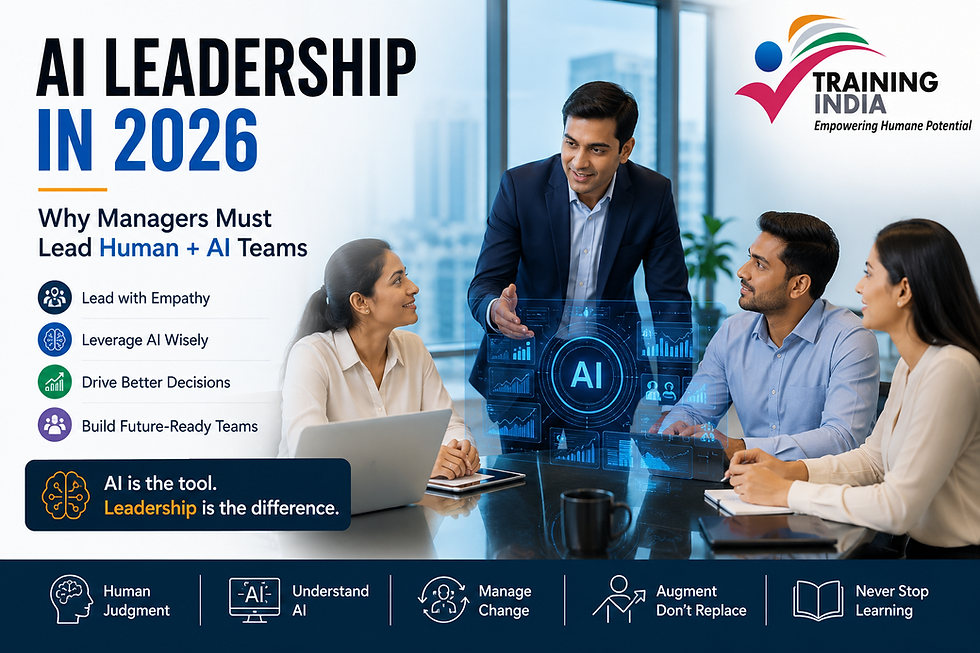
AI Leadership in 2026: Why Managers Must Lead Human + AI Teams

AI will not replace managers. But managers who know how to lead with AI will move faster, make better decisions, and build stronger teams.
Think about two sales managers in similar roles.
Both have access to the same AI tools. Both see the same market data. Both work in the same competitive environment.
Six months later, one team is consistently ahead on targets, more responsive to customers, and better aligned internally. The other is struggling with confusion, uneven adoption, and low engagement.
What made the difference?
It was not the technology.
It was leadership.
According to Microsoft’s 2025 Work Trend Index, AI is becoming part of everyday work, but many organizations are still figuring out how to help employees use it well. The report points to a growing need for leaders who can bring AI into daily workflows without losing human judgment, collaboration, and accountability.
For HR leaders and business heads, this is an important shift. AI is no longer just an IT topic. It is becoming a leadership capability.
Why AI Leadership Matters More Than AI Adoption
Over the last few years, companies have invested heavily in AI tools to improve productivity, reduce repetitive work, and speed up decision-making.
But technology alone rarely creates transformation.
The organizations seeing real business impact are the ones where managers know when to use AI, when to question it, and when human judgment should take over.
As management thinker Peter Drucker said:
“Culture eats strategy for breakfast.”
The same is true for AI.
Without the right leadership behaviour, even the best AI tools become underused, misunderstood, or misapplied.
Today, managers are expected to lead people and intelligent systems at the same time. That requires a very different mindset from traditional supervision.
The New Reality for Indian Organizations
India is among the fastest adopters of workplace AI globally.
Across manufacturing, banking, pharmaceuticals, IT services, FMCG, healthcare, and retail, AI is slowly moving from experimentation to everyday use.
That means managers are now expected to:
make faster decisions using AI-supported insights
coach employees who use AI differently
ensure responsible and ethical AI usage
balance automation with customer relationships
improve productivity without weakening engagement
This is a big change from older styles of people management.
Managers are no longer just responsible for task completion. They are responsible for helping teams work intelligently in a changing environment.
From Managing People to Leading Human+AI Teams
The role of the manager is evolving.
Earlier, success often meant supervising work, checking progress, and solving problems manually.
Today, effective managers need to orchestrate three things together: people, process, and AI.
Traditional Management | AI Leadership |
Managing employees | Managing people and AI systems |
Tracking activities | Improving business outcomes |
Solving every problem personally | Asking better questions using AI insights |
Giving instructions | Coaching informed decision-making |
Measuring effort | Measuring value creation |
AI is not replacing leadership. It is raising the bar.
Managers who adapt to this shift become stronger decision-makers because AI can handle routine analysis while leaders focus on strategic thinking, communication, and judgment.
The Five Pillars of AI Leadership
A practical framework for HR teams developing future-ready managers is the HUMAN Framework.
H - Human Judgment
AI can process large volumes of information, but it cannot fully understand culture, emotions, ethics, or business context.
That is where leaders matter.
Managers still need to make decisions that involve empathy, values, risk, and context. AI can support the decision. It cannot replace the responsibility.
U - Understand AI Capabilities
Many employees either trust AI too much or avoid it completely.
Good leaders understand:
what AI does well
where AI makes mistakes
when human intervention is essential
This balance improves productivity and also reduces poor decision-making.
M - Manage Change
Most technology adoption problems are really change management problems.
People do not resist AI because it exists. They resist it when the purpose is unclear, the process is forced, or the benefits are not explained well.
Managers who communicate clearly, address concerns early, and involve their teams in the transition create better adoption and stronger engagement.
A - Augment, Don’t Replace
The best organizations use AI to strengthen human capability, not remove it.
For example:
sales teams use AI to prepare for meetings
HR teams use it to draft role descriptions
customer service teams use AI-assisted responses
managers use AI to review employee feedback before coaching conversations
AI handles repetitive work.
People bring trust, relationships, and innovation.
N - Never Stop Learning
AI will keep changing.
That means leadership development must keep changing too.
Organizations that invest in continuous capability-building will move faster than those relying on one-time technology training.
In the AI era, learning is not a support activity. It is a business advantage.
Common Mistakes Organizations Make
Many AI initiatives fail to deliver expected results because leadership capability is missing in the plan.
Some common mistakes include:
buying AI tools before preparing managers
assuming employees will automatically know how to use AI
measuring AI adoption instead of business outcomes
ignoring ethics and governance
treating AI as an IT project instead of a business transformation effort
Without capable managers, AI can create more complexity instead of less.
A Practical Checklist for HR Leaders
Before scaling AI across the organization, HR can ask:
AI Leadership Readiness Checklist
□ Do managers understand AI beyond basic prompting?
□ Have leaders been trained on responsible AI usage?
□ Can managers coach employees on using AI in daily work?
□ Are AI-related decisions aligned with organizational values?
□ Is leadership communication supporting AI adoption?
□ Are business outcomes being tracked along with AI usage?
□ Is continuous learning built into the capability strategy?
If several answers are “No,” the organization may have a technology strategy, but not yet an AI leadership strategy.
The Business Case for AI Leadership
Organizations often spend heavily on platforms, licenses, and digital infrastructure.
But the real competitive edge comes from people who know how to use these tools well.
Managers who combine technology with emotional intelligence, critical thinking, communication, coaching, and sound judgment consistently deliver better business outcomes.
AI may generate information in seconds.
Only capable leaders can turn that information into better decisions, stronger teams, and sustainable performance.
That is why the question is no longer whether managers should build AI leadership capability.
The real question is how quickly they can build it before competitors do.
Final Thoughts
The future of work will not be led by AI alone.
It will be led by managers who know how to bring together technology, people, and purpose.
Organizations that invest in leadership capability alongside AI adoption are more likely to build resilient teams, support responsible innovation, and deliver lasting business impact.
For HR and L&D leaders, this is a useful moment to rethink leadership development. The goal is not to replace existing skills, but to expand them for an AI-enabled workplace.
If your managers are facing similar challenges, customized capability-building interventions can help bridge the gap between technology adoption and business performance.
Training India partners with organizations across India to design practical, business-focused learning experiences in leadership development, managerial effectiveness, AI at the workplace, sales excellence, communication, and behavioural skills. If you are exploring how to prepare your leaders for the future of work, our team would be glad to discuss your learning priorities.
📞 Start a Conversation : +91 9767955858 / 9764511004 🌐 www.trainingindia.com
Comments