


Your Employees Don't Need More Training.

They Need Permission.
Here is the thing nobody in corporate India says out loud: your people already know more than they are showing you.
They know the meeting is a waste of time. They know the process is broken. They know exactly why the client is not buying. They know what their manager is doing wrong.
They just don't say it.
And you respond by booking more training.
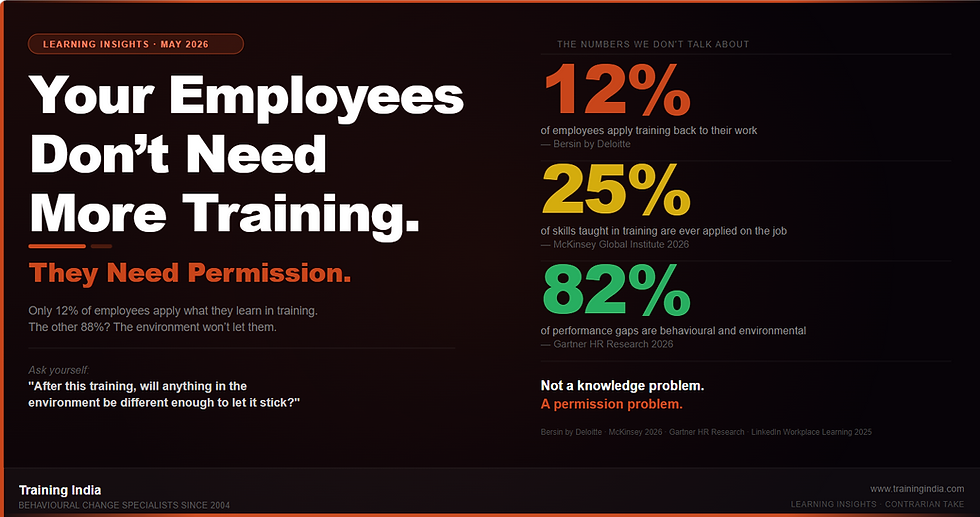
THE ACTUAL NUMBERS $300B+ spent on corporate training globally. 70% of it forgotten within a week. - Gartner 25% of skills taught in formal training are ever applied on the job. - McKinsey 2026 Only 12% of employees apply what they learned in training back to their work. - Bersin by Deloitte |
Read that last number again. Only 12%. Meaning 88 paise of every rupee you spend on training produces no change in how people work.
This is not a training content problem. It is not a vendor problem. It is not even a budget problem.
It is a permission problem.
- What 'Permission' Actually Means
McKinsey's 2026 research on workplace performance identified something uncomfortable: in most organisations, employees self-censor at an extraordinary rate. They have the knowledge. They have the solution. They hold back because the culture - often unintentionally - punishes people for using what they know.
The manager who attended the coaching workshop and went back to a boss who still rewards directive leadership. What does she do? She stops coaching.
The salesman who learned consultative selling but returns to a team measured purely on call volume. What does he do? He goes back to pitching.
The analyst who spotted the strategic risk but works in a room where challenging leadership has visible consequences. What does she do? She stays quiet.
Training gave them the knowledge. The environment took away the permission.
"We do not have a skills shortage. We have a silence surplus." |
- The Expensive Myth L&D Has Been Selling Itself
For decades, the corporate training industry has operated on one assumption: give people better knowledge and you will get better performance.
It sounds logical. It is largely false.
The WEF's Future of Jobs Report 2025 makes a critical distinction: the organisations closing their performance gaps fastest are not the ones training harder - they are the ones redesigning the environment in which learning is applied.
In plain language: it is not what your people know in a classroom. It is whether they feel safe, empowered, and rewarded for applying it on a Tuesday afternoon when pressure is high and the old habit is easier.
75% of learning happens on the job - not in training rooms. - LinkedIn Workplace Learning 2025
82% of performance gaps are behavioural and environmental - not knowledge-based. - Gartner HR Research 2026
- So What Should You Actually Do?
Stop asking: what training do my people need?
Start asking: what is stopping my people from using what they already know?
The answer will almost always be one or more of three things:
• The manager's behaviour contradicts what was trained. If your manager rewards speed over coaching, your coaching training is dead on arrival.
• The culture penalises the behaviour you trained. If speaking up gets someone side lined, no amount of communication training will make your people speak up.
• The system rewards the old behaviour. If your performance metrics still measure what they always measured, your people will do what they always did - regardless of what they learned.
This is the domain of behavioural change. And it is not the same as training.
Behavioural change asks: what does the environment need to look like, what does the manager need to do differently, and what needs to be rewarded - for the new knowledge to become the new habit?
That is a harder question than 'which vendor should we book?' It is also the only one worth asking.
- The Honest Summary
Your people are not undertrained. They are over-managed, under-trusted, and operating in environments that were never designed to let new behaviour survive.
The next time you are about to book a training programme, pause for 60 seconds and ask one question:
"After this training, will anything in the environment actually be different enough to let new behaviour stick?"
If the answer is no - you are not solving the problem. You are postponing it.
OVER TO YOU What is the one thing in your organisation's culture that quietly undoes your best training work? |
Training India We are behavioural change specialists. We don't sell training. We solve the business problems that training alone never could. 📞 Start a Conversation: +91 9764511004 / 9767955858 |
Comments