


AI Tools Are Everywhere. But Are Your Employees Making Better Decisions?

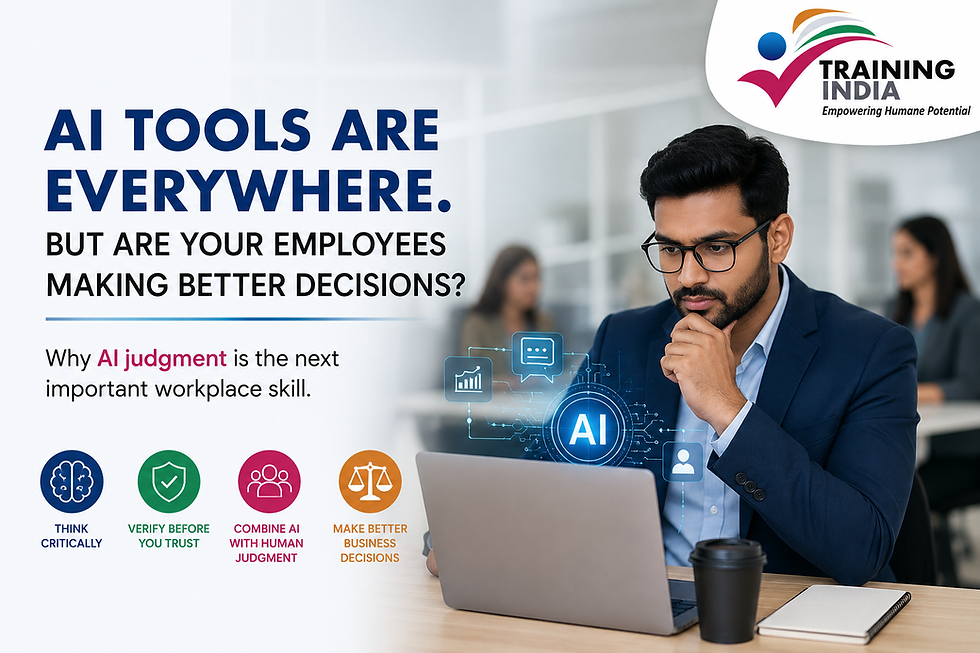
A practical perspective for HR leaders, L&D professionals, and corporate managers.
Every few years, the workplace changes because of a new technology.
First, it was computers.
Then smartphones.
Then cloud technology.
And today, it's Artificial Intelligence (AI).
Almost every organization is encouraging employees to use AI tools like ChatGPT, Microsoft Copilot, Gemini, or Claude to save time and improve productivity.
That's a good thing.
But after interacting with hundreds of managers and employees during training sessions, we've noticed one important challenge.
Many employees know how to use AI. Very few know how to use it wisely.
And that's where organizations need to shift their focus.
Using AI Is Easy. Using It Correctly Is the Real Skill.
Imagine this.
An employee asks AI to write an email to a client.
Within seconds, the email is ready.
Looks professional.
Good English.
Perfect formatting.
The employee clicks "Send."
But later, they realize the email contains incorrect information about the project.
The AI didn't know the latest updates.
The employee forgot to verify it.
The problem wasn't the AI.
The problem was trusting the AI without thinking.
This is becoming more common than many organizations realize.
AI Can Help You Work Faster. It Cannot Think for You.
AI is an excellent assistant.
It can help you:
Write emails
Prepare presentations
Summarize long reports
Generate ideas
Analyze large amounts of information
Create meeting notes
But AI cannot fully understand:
Your company's culture
Your client's expectations
Your organization's policies
Human emotions
Business relationships
That's where human judgment is still essential.
What We Are Seeing During Corporate Training Programs
During our training sessions, we often ask participants one simple question:
"Do you verify AI's answers before using them?"
The responses are interesting.
Some employees say,
"Most of the time."
Some admit,
"Honestly, I don't."
Others simply assume,
"If AI generated it, it must be correct."
This mindset can create unnecessary business risks.
AI is powerful.
But it is not perfect.
The Next Important Workplace Skill
A few years ago, organizations focused on teaching employees how to use Excel.
Later, everyone wanted to learn Power BI.
Now everyone wants AI training.
But the next important workplace skill isn't just learning AI.
It's learning how to think while using AI.
Employees should know how to ask questions like:
Is this information correct?
Does it match our business situation?
Is anything missing?
Should I verify this before sharing it?
Would I confidently present this to my client or manager?
These simple questions make a big difference.
What HR and L&D Teams Should Focus On
Many organizations proudly say,
"Our employees are using AI."
That's great.
But,
Are your employees making better decisions because they are using AI?
Because AI adoption alone doesn't improve performance.
Better decision-making does.
As HR and L&D professionals, our goal should not only be to teach employees how to use AI tools.
Our goal should be to help them become smarter decision-makers.
Skills Employees Need in the AI Era
Here are a few capabilities every organization should start developing.
1. Critical Thinking
Employees should learn to question AI instead of accepting every answer.
2. Better Decision-Making
AI can provide suggestions.
People still make the final decision.
3. Responsible Use of AI
Employees should know what information should never be shared with AI tools and understand their organization's data privacy guidelines.
4. Communication Skills
Even the best AI-generated email cannot replace empathy, trust, and meaningful human conversations.
These skills remain just as important as ever.
5. Problem-Solving
AI can offer multiple solutions.
Employees must choose the one that makes the most sense for the business.
What Effective AI Training Should Look Like
Instead of only teaching employees how to write prompts, organizations should create learning experiences based on real workplace situations.
For example:
How should a manager verify an AI-generated performance review?
How can a salesperson improve an AI-written proposal before sending it to a client?
How should HR use AI without introducing bias into hiring decisions?
How can customer service teams use AI while still delivering a personal experience?
When employees practice these real-life scenarios, they don't just learn AI.
They learn better judgment.
And that's what creates long-term value.
The Human Advantage Is More Important Than Ever
People often ask,
"Will AI replace employees?"
A better question is,
"Will employees who use AI wisely outperform those who don't?"
The answer is yes.
The future belongs to professionals who combine technology with human skills.
People who can think critically.
Communicate effectively.
Build relationships.
Make sound decisions.
And use AI as a support system not as a replacement for their own thinking.
Final Thoughts
AI is changing the way we work.
There is no doubt about that.
But successful organizations won't be the ones with the most AI tools.
They will be the ones with employees who know when to trust AI, when to question it, and when human judgment matters most.
Technology will continue to evolve.
Human thinking, good judgment, and responsible decision-making will always remain valuable.
That is where the future of workplace learning lies.
About Training India
At Training India, we believe that effective learning should create lasting behavioral change - not just transfer knowledge. We partner with organizations across industries to deliver practical, engaging, and business-focused learning solutions in Leadership Development, Communication Skills, AI & Digital Dexterity, Managerial Effectiveness, Emotional Intelligence, Sales Excellence, and other future-ready capabilities.
Our programs are designed around real workplace challenges so that employees can immediately apply what they learn and deliver measurable business results. 📞 Start a Conversation : +91 9767955858 / 9764511004 🌐 www.trainingindia.com


Comments