


Nobody Noticed That Arjun Was Drowning.

He Was Too Busy Keeping Everyone Else Afloat.
Middle manager burnout is the most expensive crisis your organisation is not talking about. Here is the story of how it happens - and what to do before it destroys the very centre of your business.
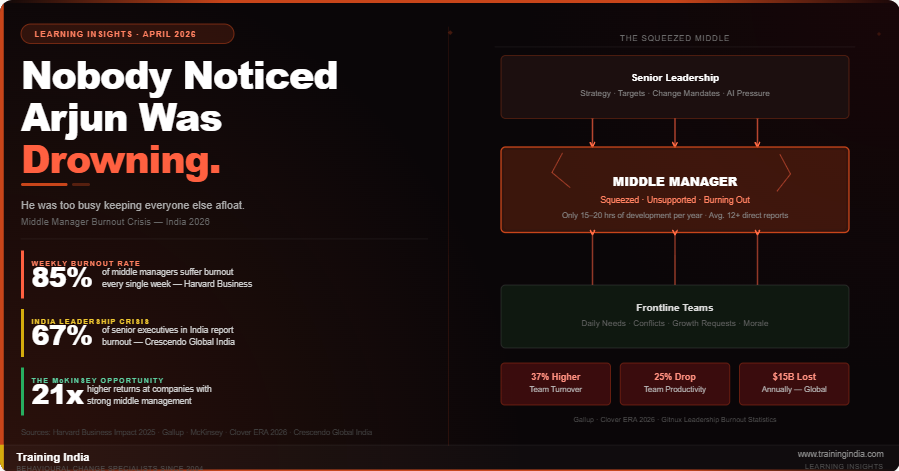
The Story of Arjun - The Manager Nobody Checked On
Arjun had been with the organisation for seven years.
He joined as a sales executive in Pune. He worked harder than anyone in the room. He was promoted to team leader at 28, and manager at 31. He trained 14 people who are now leading their own teams. His skip-level loved him. His team trusted him. His numbers were almost always green. Then one Monday in February, Arjun did not come to work. Not because he was sick. Not because of a family emergency. He sat in his car in the parking lot for forty minutes. He could not make himself walk in. He called his wife. He said: I am so tired. Not physically. Just... empty. He had not taken a single day off in eleven months. He had attended 23 leadership review calls in January alone. He was managing upward anxiety, downward pressure, and horizontal conflict - simultaneously, every day. And not once - not once - had anyone asked him how he was doing. |
Arjun is not an exception. Arjun is your most common profile in every mid-size and large organisation across India in 2026.
He is the person who holds the organisation together. And he is the person the organisation has forgotten to hold.
"Burnout among midlevel leaders has become the norm. 85% report experiencing it every week. They are not asking for lighter loads. They are asking for stronger reinforcements." - Harvard Business Impact, 2025 |
The Scale of the Crisis - And Why It Is Getting Worse
Middle managers in India in 2026 are being asked to do more than any previous generation of managers has ever been asked to do - and receiving less support than any previous generation has ever received.
Consider what a typical middle manager's job now involves:
Execute the strategy handed down from leadership - even when they were not consulted in designing it
Protect their teams from organisational anxiety - absorbing pressure so it does not cascade downward
Navigate AI adoption and digital transformation - leading change they themselves are still learning
Retain their best people - in a market where 82% of employers are struggling to fill roles
Attend more meetings, complete more reporting, and manage larger teams than five years ago
And they are doing all of this while receiving an average of just 15 to 20 hours of formal development support per year. That is less than 30 minutes per week.
The result is not just individual suffering. It is organisational contagion. Research shows that burned-out managers directly cause 37% higher employee turnover in their teams and a 25% drop in team productivity. The crisis does not stay at the middle. It flows downward - into every team, every project, every customer interaction.
▸ THE HIDDEN COST OF MIDDLE MANAGER BURNOUT - INDIA 2026 → $15 billion lost annually in turnover costs from middle manager burnout - Clover ERA 2026 → 37% higher employee turnover under burned-out managers - Gitnux Leadership Burnout Statistics 2026 → 25% drop in team productivity when the manager is running on empty → Burned-out managers stop advocating for their teams - promotions, resources, and recognition disappear → Leadership pipelines dry up as burned-out managers stop aspiring upward - Crescendo Global India → 86% of Indian professionals reported major workplace disruptions in 2026 - ETS Human Progress Report |
Why Organisations Keep Missing It - Until It Is Too Late
The cruelest irony of middle manager burnout is that the best managers hide it the longest. They were promoted because they were resilient, solution-oriented, and dependable. Those same qualities make them experts at absorbing pain without signalling distress.
By the time the symptoms show up in data - a spike in attrition, a drop in team performance, an unexpected resignation - the burnout has been building for six to twelve months.
Three warning signs most HR and L&D leaders miss:
The quiet manager. A previously outspoken manager who stops challenging decisions in leadership meetings has not become agreeable. They have run out of energy to fight battles they no longer believe they can win.
The shrinking 1:1. When a manager's one-on-one conversations with their team members shrink from growth conversations to status updates, it is a signal they have nothing left to give beyond the minimum.
The invisible advocate. Burned-out managers stop raising their team's wins in senior meetings. They stop fighting for promotions and recognition for the people below them. This is one of the most overlooked early signs - and one of the most devastating for team morale.
The Opportunity Hidden Inside This Crisis
Here is what the burnout data does not tell you at first glance. McKinsey's organisational health research found that companies with strong middle management capabilities deliver shareholder returns 3 to 21 times higher than their peers. Not incrementally better. Twenty-one times.
Your middle managers are not a problem to be managed. They are the single most powerful, most underutilised performance lever in your organisation. The companies that understand this in 2026 - and invest accordingly - will not just reduce burnout. They will build an organisational advantage that cannot be replicated with technology, process, or strategy alone.
Because culture lives in the middle. Execution lives in the middle. Retention lives in the middle.
And if the middle collapses, nothing else works.
What Happened to Arjun
Arjun did eventually walk into the office that morning. He spent the next three months quietly disengaging - doing just enough, never more.
Six months later, he resigned for a 15% salary increase at a competitor. His manager was surprised. His skip-level said they never saw it coming.
But the two people on his team who resigned two months after him? They did not leave for the money. They left because Arjun was gone.
Three resignations. One root cause. One missed opportunity to ask a good manager how he was doing.
"Middle managers are the bridge between vision and execution. When that bridge cracks, neither the strategy above nor the work below can hold." - Training India Learning Insights, April 2026 |
Your Immediate Action Plan as an L&D or HR Leader
You do not need a six-month program to start protecting your middle layer. You need three moves this week:
Run a Pulse Check - Just Ask. Schedule a 20-minute conversation with your top 10 middle managers this month. Ask them one question: on a scale of 1 to 10, how supported do you feel right now? Their answers will tell you everything your engagement surveys are missing.
Audit Their Load, Not Just Their Performance. Count how many direct reports, meetings, reporting responsibilities, and cross-functional projects each manager is carrying. If the number is above 10 direct reports with no additional support, you have a structural problem that no amount of wellness programming will fix.
Invest in Their Development, Not Just Their Output. Your middle managers receive the least development investment of any tier. Reverse that. One structured behavioral development program targeted specifically at your middle management layer will return more value per rupee than almost any other L&D investment you can make in 2026.
HOW TRAINING INDIA CAN HELP YOUR ORGANISATION Your Middle Managers Are Not Weak. They Are Unsupported. At Training India, we have seen this crisis up close - in manufacturing plants in Pune, in BFSI floors in Mumbai, in IT corridors in Bengaluru. The middle manager who starts every Monday full of energy and ends every Friday running on fumes. The team leader who has become a task-tracker instead of a culture-builder. The department head who stopped sharing ideas in leadership meetings because nobody was listening anyway. This is not a personal failing. It is a behavioural and structural problem - and it has a solution. As behavioral change specialists, Training India designs programs that rebuild the inner architecture of your middle management layer. Not with workshops that fade in a fortnight, but with sustained behavior change that makes your managers stronger, more resilient, and more capable of leading in the complexity of 2026. Our middle manager development programs are built to: ✓ Rebuild emotional resilience - so managers can absorb pressure without passing it down ✓ Develop authentic communication skills - so they can hold honest conversations upward and downward ✓ Install coaching behaviors - so every 1:1 becomes a growth conversation, not a status update ✓ Restore a sense of purpose and identity - so managers lead from meaning, not just obligation ✓ Connect every intervention directly to your business outcomes - not just wellbeing scores The organisation that invests in its middle managers in 2026 will not just reduce burnout. It will unlock the single most powerful lever of performance, culture, and growth it already has. 📞 Start a Conversation : +91 9767955858 / 9764511004 🌐 www.trainingindia.com |


Comments