


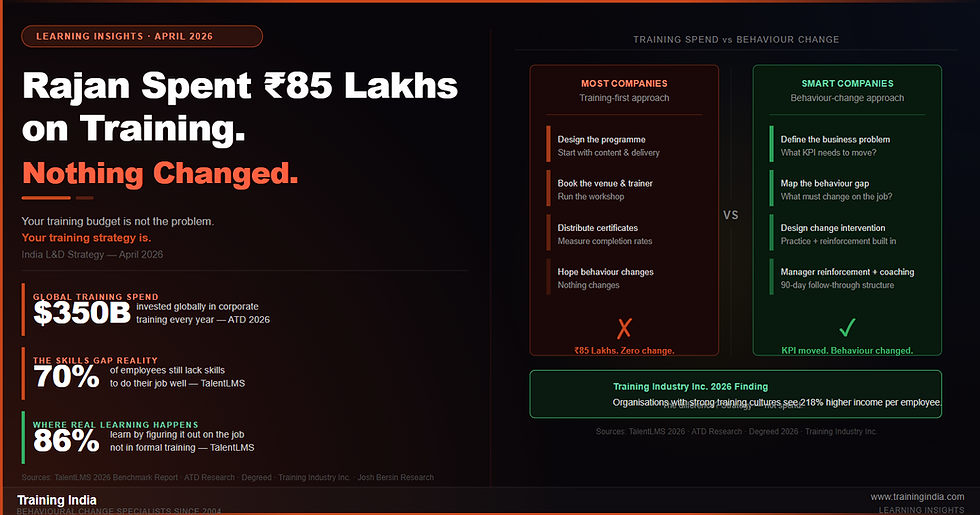
Rajan Spent ₹85 Lakhs on Training Last Year.

His Team Behaved Exactly the Same.
Companies globally invest $350 billion in training every year. Yet 70% of employees still feel they lack the skills to do their jobs. Something is deeply broken - and it is not the budget. Here is what India's smartest L&D leaders are doing differently in 2026.
$350B Invested globally in corporate training annually - ATD 2026 | 70% Of employees still feel they lack skills to do their job well | 86% Of employees learn by figuring it out on the job - not in training | 62% Of HR managers say their own training programmes miss employee needs |
The Story of Rajan - And the ₹85 Lakh Question
Rajan had done everything right. He was the VP of HR at a mid-sized pharmaceutical company in Ahmedabad. In FY 2025-26, he had the largest L&D budget in the company's history. He used every rupee. Six leadership programmes. Four communication workshops. An entire digital learning library for 1,400 employees. Completion rates were above 90%. Feedback scores were consistently high. At the annual review, his CHRO asked one question: "What has actually changed in how people work?" Rajan paused. He thought about the regional managers who still avoided difficult conversations. He thought about the sales teams who had attended three negotiation workshops - and still caved on price in every deal. He thought about the frontline supervisors who could recite the feedback model perfectly - and still never used it on the floor. He had spent ₹85 lakhs. He had 1,400 completion certificates. He could not answer his CHRO's question. |
Rajan is not a bad HR leader. He is an extremely common one. And the problem he faced is not a budget problem, a vendor problem, or a content problem.
It is a strategy problem.
Specifically: a strategy that was designed to deliver training - when the goal was always supposed to be performance.
"70% of employees say they lack the skills to do their jobs - despite their companies spending billions on training. The problem is not investment. It is approach." - TalentLMS 2026 L&D Benchmark Report |
The Broken Model - Why Traditional Training Fails
The traditional corporate training model was built for a different era. It assumes that if you give people the right information in the right format, delivered by the right facilitator, performance will follow. It does not.
TalentLMS's landmark 2026 L&D Benchmark Report confirms what experienced L&D professionals have quietly known for years: 86% of employees say they pick up new skills by figuring things out on the job - through real challenges, real feedback, and real consequences. Not in a classroom. Not on a learning management system. Not in a two-day offsite.
And yet, the majority of corporate training budgets in India are still allocated to exactly those formats: workshops, e-learning modules, and certification programmes that are measured by completion rates, not behaviour change.
▸ WHY THE TRAINING CALENDAR MODEL IS FAILING INDIA'S ORGANISATIONS → Training is designed to inform - not to change behaviour. Information without application fades within 72 hours → 62% of HR managers admit their own programmes do not meet actual employee needs - ATD Research → Learning is treated as an event, not a process - one workshop cannot rewire a behaviour pattern built over years → Managers are never trained to reinforce new behaviours back in the workplace - the most critical missing link → Success is measured by completion, not capability - certificates hide the real performance gap → The velocity of change in 2026 means annual training calendars are obsolete before they are even published |
The Real Problem Has a Name - The Knowing-Doing Gap
In 1999, Stanford professors Jeffrey Pfeffer and Robert Sutton identified what they called the Knowing-Doing Gap - the enormous chasm between what people know they should do and what they actually do in the moment of pressure, habit, and real-world complexity.
In 2026, that gap has not shrunk. It has widened. Because the pace of change means employees are being asked to adopt new behaviours faster than ever - while receiving training that is more information-heavy and less behaviour-focused than ever.
Your regional manager knows the coaching model. He reverts to directing the moment a deadline arrives. Your senior executive has attended three communication workshops. She still dominates every meeting. Your frontline supervisor can recite the performance review framework. He still avoids the conversation.
This is not a knowledge problem. It is a behaviour problem. And behaviour problems require a completely different approach to learning.
What Actually Works - The Strategy Shift India's Best L&D Leaders Are Making
The organisations that are getting genuine ROI from their L&D investment in 2026 have made one fundamental shift. They have moved from designing training programmes to designing behaviour change. The difference is everything.
Training Programme | Behaviour Change Strategy |
Starts with: what content do we need? | Starts with: what business problem are we solving? |
Measured by: completion rates | Measured by: on-the-job performance change |
Delivered in: a classroom or LMS | Embedded in: the daily flow of work |
Owned by: the L&D team | Owned by: managers + L&D + leadership together |
Ends when: the session is over | Continues through: coaching, reinforcement, accountability |
Success signal: happy sheets | Success signal: business KPI movement |
Degreed's research on L&D trends for 2026 found that the velocity of business change has decisively outpaced the traditional training model. The organisations winning in this environment are not the ones spending the most on learning - they are the ones whose learning strategy is most closely connected to behaviour and business outcomes.
"In 2026, your ability to build new capabilities will matter more than any single technology choice. The goal is not learning. The goal is workforce transformation." - Degreed - Top 7 L&D Trends for 2026 |
What Rajan Did Next - And What Changed
After that uncomfortable CHRO conversation, Rajan made one decision that changed everything. He stopped building a training calendar and started building a behaviour change plan.
He identified three business-critical behaviours his organisation needed in FY 2026-27: managers who could coach rather than direct; sales teams who could lead with value rather than price; and leaders who could give honest feedback without damaging relationships.
For each behaviour, he worked with a specialist behavioural training partner to design a programme that included pre-work, facilitated sessions, on-the-job practice assignments, manager reinforcement tools, and a 90-day follow-through coaching structure.
Six months later, he went back to his CHRO with a very different answer. Price discounting in the sales team had dropped by 18%. Manager-led coaching conversations had increased by 3x. And for the first time in three years, the organisation's key performance conversations were happening without HR having to prompt them.
Same company. Different strategy. Completely different results.
Your 3-Step Strategy Reset - Start This Quarter
Audit your last year of training against business outcomes. For each programme you delivered, ask: what behaviour was this designed to change? And did it? If you cannot answer the first question, that is the root of the problem.
Identify your top three business-critical behaviours. Work with your business leaders to identify the three behaviours that, if changed, would most directly move your most important business metrics. Design your entire L&D strategy around those three behaviours for the next 12 months.
Stop measuring completion. Start measuring change. Redesign your L&D measurement framework to capture behaviour change indicators: are managers having more coaching conversations? Are salespeople holding price better? Are leaders giving feedback more often? These are the numbers your CHRO actually needs.
HOW TRAINING INDIA CAN HELP YOUR ORGANISATION We Don't Fill Training Calendars. We Solve Business Problems. At Training India, we hear the same story from L&D and HR leaders across India - budgets approved, vendors selected, programmes delivered, certificates distributed. And six weeks later, nothing has changed. The manager who struggled with difficult conversations still avoids them. The sales team that needed to build trust with clients is still leading with features. The leaders who needed to inspire their teams are still managing tasks. The problem was never the training budget. The problem is that training was designed to inform, not to transform. Information without behaviour change is just knowledge that goes unused. As behavioural change specialists, Training India starts from a different place. We begin with your business problem - the real one, not the training request. We ask: what behaviour, if changed, would move the needle on this business outcome? Then we design a programme that creates that specific behaviour change - measurably, sustainably, and in the context of your industry and your people. Our approach is built to: ✓ Close the gap between knowing and doing - the most expensive gap in any organisation ✓ Design learning interventions that change on-the-job behaviour, not just classroom scores ✓ Connect every programme directly to a measurable business KPI - not a completion certificate ✓ Build manager capability to reinforce new behaviours back in the workplace ✓ Create sustained change through follow-through coaching, not one-time workshops "The goal of training is not learning. The goal is performance. And performance lives not in the classroom - but in the daily behaviour of your people." 📞 Start a Conversation : +91 9767955858 / 9764511004 |

Comments