


Silence Is Costing You Crores

The Hidden Crisis of Psychological Safety in India’s Workplaces
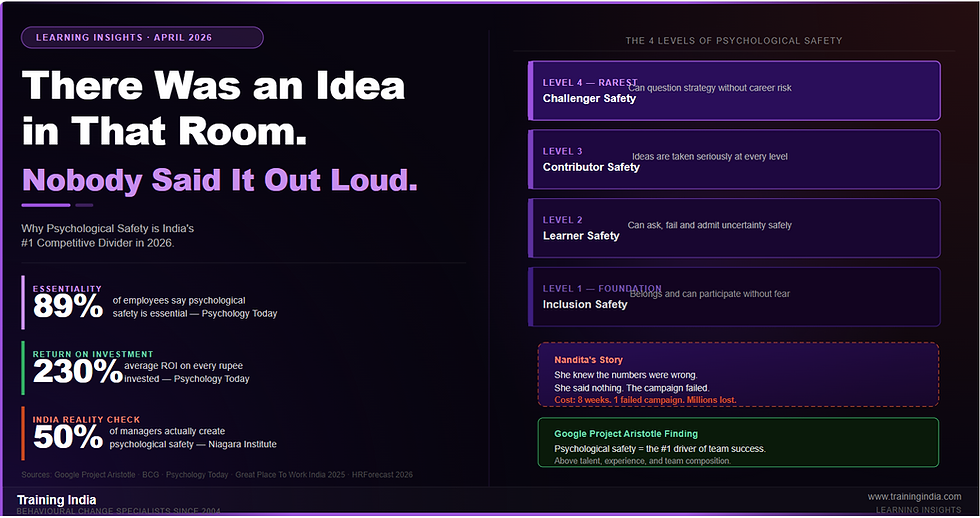
89% of employees say psychological safety is essential. Only 50% say their manager actually creates it. The gap between those two numbers is the gap between an organisation that innovates and one that slowly suffocates - one unspoken thought at a time.
The Meeting That Changed Everything - And Nothing
Nandita had been staring at the slide for eleven seconds. She was a senior analyst at a fast-growing fintech company in Bengaluru. The slide showed a projection. The numbers were wrong. Not slightly wrong. Significantly wrong. The entire Q3 strategy had been built on a flawed assumption. She knew it. She had spotted it two days ago, run it past a colleague, double-checked it. The Head of Strategy was presenting. The CEO was in the room. Three VPs. Nandita opened her mouth. Then she closed it. She thought about the last time someone had pushed back in a meeting like this. She remembered the look on that person's face when the room went quiet. She remembered how that person was not invited to the next strategy session. So Nandita said nothing. The strategy was approved. Eight weeks later, the campaign failed. The numbers did not lie. And at the post-mortem, the Head of Strategy said the words that haunt every L&D and HR leader: "Why did nobody raise this earlier?" |
Nandita had raised it. Silently. In her own mind. And then buried it. Because the cost of speaking up felt higher than the cost of staying quiet.
That gap between what employees know and what they feel safe saying - is the most expensive gap in your organisation. And in 2026, it has a name: the absence of psychological safety.
"Psychological safety will become the defining competitive divider of 2026. It will separate organisations that thrive from those that stagnate." - Ranjith Menon, SVP Corporate HR, Hinduja Global Solutions - HR Forecast 2026 |
What Psychological Safety Actually Means - And What It Does Not
Psychological safety is not a happiness index. It is not a no-conflict zone. It is not ping-pong tables and free lunch.
Amy Edmondson, the Harvard Business School professor who first defined it, describes it as "the shared belief that the team is safe for interpersonal risk-taking." In plain language: your people believe that speaking up, asking questions, making mistakes, or challenging a decision will not result in punishment, humiliation, or exclusion.
Google spent two years studying 180 teams to find out what made some extraordinary and others average. Their landmark Project Aristotle research found that psychological safety was the single most important factor - more than talent, more than experience, more than team composition. Teams with high psychological safety were far more likely to collaborate effectively, admit mistakes, learn from failure, and sustain high engagement over time.
The India Problem - Why Psychological Safety Is Harder Here
Here is where this conversation gets both more important and more honest. India's workplace carries cultural inheritances that make psychological safety uniquely difficult to build - and more urgently needed than almost anywhere else.
Hierarchy is not just an org chart structure in India. It is a deeply embedded social norm. Disagreeing with a senior colleague - particularly in a group setting - carries a social cost that most employees are unwilling to absorb. The result is a workplace where significant volumes of the most useful thinking never reach the surface.
This is compounded by the pressure environment of most Indian organisations. Growth targets are aggressive. Performance pressure is intense. In this context, admitting uncertainty or raising concerns can feel like an admission of inadequacy rather than a contribution to shared problem-solving.
The cost is not just cultural. It is financial, strategic, and existential for some organisations.
▸ THE BUSINESS COST OF LOW PSYCHOLOGICAL SAFETY — INDIA 2026 → Only 3% of employees plan to quit in high-psych-safety teams. 12% plan to quit in low-psych-safety teams - BCG → Teams with high psych safety see 76% more engagement and 27% lower turnover - Peaky Research → 93% of business leaders agree it boosts productivity and innovation - Workplace Options → India's Best Workplaces deliver 14x shareholder returns vs peers - Great Place To Work India 2025 → Employees 5x more likely to be committed and loyal in psychologically safe cultures - GPTW India → Workers with high psych safety are 10x less likely to describe workplace as toxic - APA 2024 |
The Four Levels of Psychological Safety - Where Is Your Organisation?
Timothy Clark's research identifies four levels that organisations must build - in sequence - to create genuinely safe cultures:
Inclusion Safety. People feel they belong and can participate without fear of rejection. This is the foundation - and in India's hierarchical workplaces, it is frequently the first level that breaks down.
Learner Safety. People feel safe to ask questions, make mistakes, and admit what they do not know. This is where India's performance-pressure culture causes the deepest damage.
Contributor Safety. People believe their ideas will be taken seriously - that contribution from every level is genuinely valued. This is where India's best talent most commonly disengages.
Challenger Safety. People feel safe to question the status quo, challenge strategy, or raise uncomfortable truths - without career consequences. This is the rarest and most powerful level. And it is what separates organisations that self-correct from those that repeat expensive mistakes.
Nandita was stuck between Level 2 and Level 3. She had the knowledge. She lacked the safety. And the organisation paid the price - not because it lacked talent, but because it had not invested in the conditions that allow talent to speak.
"The most foundational level - inclusion safety - is frequently undermined by visible hierarchies and informal networks that leave certain employees perpetually on the margins of decision-making." - Building Psychological Safety at Work: A Practical Framework for Indian Leaders, March 2026 |
What Most Leaders Get Wrong About Psychological Safety
The most common mistake Indian leaders make is treating psychological safety as a communication initiative - run a town hall, encourage open feedback, set up an anonymous suggestion box.
Psychological safety is not built through initiatives. It is built through daily behaviour. Specifically, the behaviour of the most senior person in the room.
• How a leader responds when someone raises a risk they missed - with curiosity or defensiveness?
• How a leader reacts when a junior team member contradicts them in front of others with openness or visible displeasure?
• How a leader treats the person who delivered bad news - with appreciation or with visible frustration?
• How a leader runs a meeting - do they speak first (closing down input) or last (after others have shared)?
These are not culture questions. They are behavioural questions. And they cannot be answered by a policy document, a leadership offsite, or an engagement survey. They are answered every day - in microseconds - by the specific actions of specific people.
What Nandita's Company Did Next
After the campaign post-mortem, the CHRO did something unusual. She did not launch a new feedback tool or an anonymous survey.
She brought in a behavioural training partner to work directly with the leadership team - not to teach them about psychological safety, but to redesign the specific behaviours that had made Nandita's silence feel rational.
The Head of Strategy learned to pause before responding to challenges - asking one question before offering any opinion. The CEO started ending meetings by saying: "What is the thing nobody has said yet that we need to hear?" The leadership team stopped rewarding confident certainty and started rewarding honest uncertainty.
Six months later, Nandita raised an issue in a strategy meeting. This time she spoke. The idea was debated. Some of it was used. Most importantly - nothing happened to her career.
And three other people in the room who had been watching decided it was safe to speak too.
Your 3-Step Action Plan This Week
Audit your last 5 leadership meetings. Who spoke? Who stayed silent? What happened the last time someone raised a difficult point? The pattern you find will tell you your current psychological safety level more accurately than any survey.
Change one meeting behaviour this week. If you usually speak first, speak last. If someone challenges an idea, ask one clarifying question before responding. Small behavioural shifts by leaders create disproportionate ripples in team culture.
Invest in behavioural development - not just awareness. Psychological safety cannot be created by a workshop on psychological safety. It is created by changing the specific daily behaviours of your leaders and managers - systematically, sustainably, and measurably.
HOW TRAINING INDIA CAN HELP YOUR ORGANISATION You Cannot Train Psychological Safety Into a Team. You Must Behave It In. At Training India, we have sat with enough HR and L&D leaders across India to know that psychological safety is not missing from the values poster on the wall. It is missing from the daily behaviours of leaders - in the way they run meetings, respond to mistakes, handle dissent, and show up when the pressure is highest. As behavioural change specialists, we do not deliver a workshop on psychological safety. We work with your leadership teams to redesign the specific behaviours that either build or destroy psychological safety every single day. Because your people are watching. And they are making permanent decisions based on what they observe. Our behavioural programmes help your leaders and teams: ✓ Build the daily conversational habits that make speaking up feel safe — not risky ✓ Develop the courage to model vulnerability and intellectual humility from the top ✓ Rewire the meeting culture from performance theatre to genuine collaborative thinking ✓ Create accountability structures that reward honesty, not just outcomes ✓ Embed psychological safety into your L&D and performance frameworks as a measurable business metric "Psychological safety is not a culture aspiration. In 2026, it is your most powerful competitive advantage and your most measurable one." 📞 Start a Conversation - +91 9767955858 / 9764711002 |


Comments